Organizations with mature responsible AI practices report 3× higher consumer trust scores and significantly lower regulatory risk exposure compared to peers.

Alexander
Best Practices For AI
Artificial intelligence has moved well beyond the boundaries of research labs. It now approves loans, assists in medical diagnoses, screens job applications, shapes news feeds, and steers autonomous vehicles. With this sweeping influence comes an equally sweeping responsibility. Deploying AI without ethical guardrails is not just a governance risk, it is a societal one.
At Symbiotic AI, we believe that technology and humanity must evolve together. Responsible AI is the foundation of that belief. This guide explores the core principles, frameworks, and actionable best practices every organization must adopt for truly ethical AI deployment in 2025 and beyond.
77% of executives cite ethical AI as a top strategic priority in 2025
60% of AI deployments still lack formal bias-testing protocols
3× more trust from consumers in brands with transparent AI practices
What Is Responsible AI?
Responsible AI refers to developing, deploying, and managing artificial intelligence systems in a manner that aligns with ethical principles, prioritizes fairness, transparency, and accountability, and complies with legal and regulatory standards. It is not a single feature or checkbox. It is a culture, a process, and a commitment that runs through every layer of an organization.
In 2026, AI governance has become a strategic imperative for any organization seeking to leverage the transformative power of artificial intelligence responsibly and sustainably. It is the bedrock upon which responsible AI and ethical AI are built, fostering trust, mitigating risks, and ensuring that AI serves humanity's best interests.
"The question is no longer whether to use AI,it is whether you are using it in a way you can defend to your customers, your employees, and your regulators."
The Core Pillars of Ethical AI
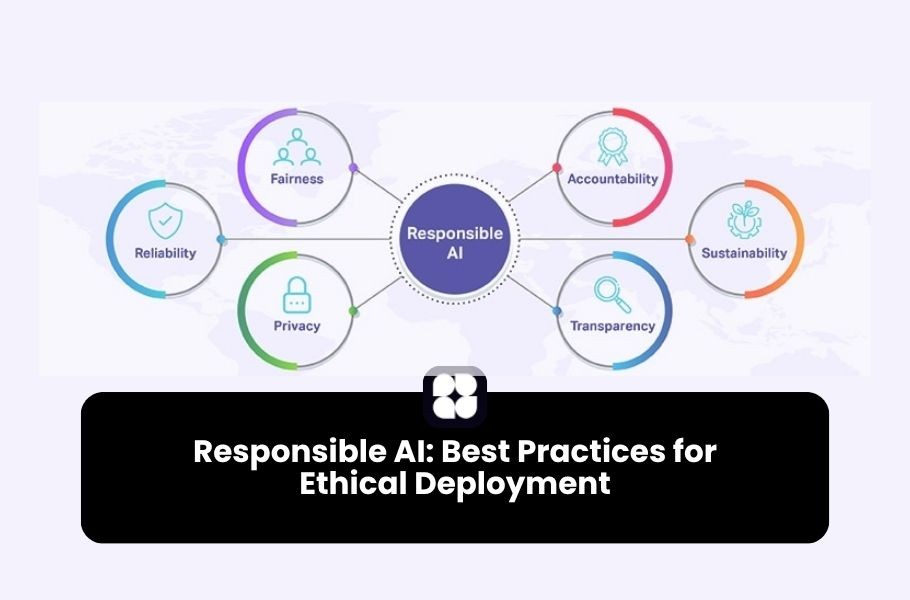
Leading frameworks from Microsoft, the EU AI Act, UNESCO, and NIST converge on several foundational principles. Understanding these pillars is the first step toward embedding them into your organization's AI strategy.
Fairness
AI systems must avoid biases and be trained on diverse datasets to ensure equitable treatment across all demographics and marginalized groups.
Transparency
Users and regulators must be able to understand how an AI system generates outputs or makes decisions, no unexplained black boxes.
Accountability
Clear lines of responsibility must exist for AI outcomes. When things go wrong, there must be a human accountable for remediation.
Privacy & Security
AI systems must protect user data, comply with GDPR, CCPA, and emerging AI-specific regulations, and resist adversarial attacks.
Inclusivity
AI should be designed to work for all, including underrepresented groups, ensuring equal access to its benefits and protections.
Safety
Systems must be secure, reliable, and resilient to failures. Safety is non-negotiable, especially in high-stakes domains like healthcare and finance.
Best Practice 1: Build Transparency Into Your Architecture
Transparency in AI means making the workings of your AI systems accessible and understandable to both users and stakeholders. It is a prerequisite for trust and trust is the currency of modern digital business.
In practical terms, this means carefully documenting data sources, model architectures, and decision algorithms. It means implementing explainable AI (XAI) techniques that can translate complex model outputs into plain language. It means publishing model cards, data sheets, and impact assessments that give the public a genuine window into your AI's behavior.
How to implement transparency in practice
Start by auditing every AI system in your organization. For each system, document what data it was trained on, what objective it optimizes for, and what guardrails are in place. Make this documentation accessible to internal stakeholders first, then consider what portions can be shared publicly to build external trust.
Explainable AI tools like SHAP (SHapley Additive exPlanations) and LIME (Local Interpretable Model-agnostic Explanations) can help translate model behavior into human-readable explanations. This is especially critical in regulated industries such as banking and healthcare, where decision rationale must often be disclosed by law.
Best Practice 2: Proactively Mitigate Bias
Bias in AI is not a hypothetical risk it is a documented reality. AI systems trained on historical data inevitably inherit the biases embedded in that data. Left unchecked, these biases can lead to discriminatory hiring decisions, unequal access to credit, and inequitable healthcare outcomes.
Responsible AI deployment requires proactive bias mitigation at every stage: data collection, model training, evaluation, and post-deployment monitoring. This means reviewing data for quality, diversity, and representation before building models. It means identifying potential sources of bias before, not after, training begins.
Techniques that work
Fairness-aware algorithms and adversarial debiasing are powerful tools for embedding equity into model behavior. Regular testing of AI outputs across demographic groups age, gender, ethnicity, socioeconomic status ensures that performance does not diverge in ways that disadvantage any population. When disparities are found, models must be adjusted before deployment, not after harm has already occurred.
Regulatory Context: What You Must Know in 2026
The EU AI Act, which began phasing in enforcement in 2024, classifies AI systems by risk level and mandates strict compliance requirements for high-risk applications including recruitment, credit scoring, and law enforcement tools. Organizations operating globally must also navigate GDPR, the CCPA (California), and sector-specific rules from the FDA and financial regulators.
Non-compliance carries more than financial penalties. A single AI-driven discrimination scandal can permanently damage a brand's reputation. Proactive governance is not just ethical it is the most cost-effective risk management strategy available.
Best Practice 3: Establish Human Oversight at Every Level
One of the most critical AI governance best practices emerging in 2026 is the Human-in-the-Loop model. This means ensuring appropriate human oversight and the ability to intervene in AI decision-making, especially for critical applications. It also includes the Human-on-the-Loop model, where humans monitor AI decisions in real time and can intervene when necessary.
Human oversight is not about distrust of AI. It is about acknowledging that AI systems, however sophisticated, cannot be fully autonomous in high-stakes environments. A medical AI system may flag a tumor, but a physician must confirm the diagnosis. A credit-scoring model may recommend a denial, but a human reviewer must have the ability to assess the case contextually.
Designing effective oversight mechanisms
Effective human oversight requires clear escalation pathways. Define which decisions require mandatory human review and which can proceed autonomously. Build override mechanisms into your AI interfaces. Train staff not just on how to use AI tools, but on when to question them, when to override them, and how to document their reasoning when they do.
Oversight also extends to the technical layer. Monitoring dashboards that track AI system performance, drift detection, anomaly flagging, and audit logs are not optional extras they are core infrastructure for any responsibly deployed AI system.
Best Practice 4: Build a Robust AI Governance Framework
AI governance is not a one-time setup. It requires ongoing iteration and adaptation as AI systems evolve, regulatory landscapes shift, and new ethical questions emerge. Organizations must establish clear AI policies, robust policy frameworks, vigilant AI risk management, and unwavering AI accountability.
A mature AI governance framework includes several interconnected elements: a set of documented ethical AI principles, a risk classification process for AI systems, audit and review cadences, clear ownership and accountability structures, and mechanisms for escalating ethical concerns without retaliation.
Governance is a leadership responsibility
Engineering leaders identify and implement engineering practices that integrate responsible AI into everyday work. But governance cannot be delegated entirely to technical teams. The C-suite and board must understand the AI systems the organization deploys, the risks they carry, and the ethical commitments the organization has made. Responsible AI starts at the top.
Organizations should develop a Responsible AI Standard, a living document covering principles such as fairness, reliability, privacy, and inclusiveness and revisit it at least annually. This standard should inform procurement decisions, vendor assessments, and product roadmaps, not just technical architecture choices.
Best Practice 5: Protect Privacy and Data Rights
As AI becomes more capable of processing vast quantities of personal data, the protection of individual privacy becomes simultaneously more important and more technically challenging. AI ethics and privacy protection are inseparable in 2025.
Innovative techniques such as differential privacy, homomorphic encryption, and federated learning have emerged as powerful tools for protecting personal information while preserving the utility of AI systems. Differential privacy allows valuable insights to be extracted from datasets while mathematically guaranteeing the anonymization of individual data points. Federated learning enables model training across decentralized data sources without centralizing sensitive information.
Consent and data governance
Responsible AI deployment requires consent-aware data processing pipelines. Users must understand what data is being collected, how it will be used to train or inform AI systems, and what rights they retain over their data. Privacy notices must be written in plain language, not legal boilerplate. Data minimization collecting only what is genuinely necessary — should be a design principle, not an afterthought.
Best Practice 6: Communicate Ethically and Build Stakeholder Trust
To communicate your ethical AI stance to the public and stakeholders, you should develop a clear ethical code within the organization and write documentation for it with specific guidelines about fairness, transparency, and accountability. This is not just internal policy — it is a public commitment.
Transparency with customers about when and how AI is being used builds the kind of trust that is increasingly rare and therefore increasingly valuable. When AI chatbots are deployed in customer service, users deserve to know they are speaking with an AI. When AI is used to personalize content or make recommendations, users deserve clarity about the criteria driving those outputs.
Ongoing education for your entire organization
Responsible AI is not a job for the data science team alone. Raise awareness and provide training on AI ethics, policies, and responsible AI practices for all relevant employees from developers to executives. When ethical considerations are an integral part of every team's thinking, not just a compliance requirement handed down from leadership, they become genuinely embedded in organizational culture.
"You can build ethical oversight into your AI governance without slowing down innovation it requires proper planning, realistic timelines, and a genuine commitment to transparency."
Best Practice 7: Monitor, Audit, and Continuously Improve
Deploying a responsible AI system is not the finish line. It is the starting line. Continuously monitoring AI systems for performance, bias, and adherence to policies is an ongoing operational discipline, not a one-time deployment check.
Conduct regular audits of AI governance processes and AI systems to ensure accountability and identify areas for improvement. AI systems can drift over time as the world changes and input data distributions shift. A model that was fair and accurate at launch can become biased and unreliable within months if left unmonitored.
What a robust monitoring program looks like
Establish key performance indicators for each AI system that go beyond standard accuracy metrics. Include fairness metrics disaggregated by demographic group, bias drift indicators, explainability scores, and user complaint rates. Set thresholds that trigger mandatory human review and model retraining. Document every audit cycle and maintain an audit trail that can be presented to regulators if required.
AI control systems are designed to monitor the actions of autonomous agents and hold them to ethical boundaries. This is not a luxury for large enterprises,it is a baseline expectation for any organization deploying AI at scale.
The Symbiotic AI Perspective
Why Responsible AI Is a Competitive Advantage
Some organizations treat responsible AI as a cost center, a compliance burden that slows innovation. This is a fundamentally short-sighted view. In an era where consumers are increasingly aware of how their data is used, how automated systems affect their lives, and how corporations exercise power, ethical AI is a powerful differentiator.
Organizations that invest in responsible AI practices build deeper customer trust, attract talent that wants to work on technology they can be proud of, reduce regulatory and reputational risk, and create more robust AI systems that actually perform better over time because they are built on quality data and sound principles.
The journey to mature AI governance involves establishing clear AI policies, robust AI policy frameworks, vigilant risk management, and unwavering accountability. As AI continues to evolve, so too must our governance approaches guided by best practices and a commitment to ensuring that AI serves humanity's best interests, not just the bottom line.
Final Thoughts: Symbiotic AI Begins Here
At Symbiotic AI, our name reflects a belief: that the most powerful future is one where humans and artificial intelligence evolve together, each making the other better. That future is only possible if the AI systems we build are worthy of the trust we ask humans to place in them.
Responsible AI is not a constraint on innovation. It is the condition under which innovation earns the right to be trusted. Transparency, fairness, accountability, privacy, inclusivity, human oversight, and continuous improvement are not ideals to aspire to someday. They are the standards every AI deployment should meet today.
The stakes are high. The tools are available. The frameworks exist. What remains is the organizational will to deploy AI the right way not just the fast way.
About Symbiotic AI: Symbiotic AI is dedicated to building the bridge between human intelligence and artificial intelligence through ethical, transparent, and accountable technology frameworks. We help organizations deploy AI responsibly, at scale
